Need the Right Safety Light Curtain for Your Machine?
Tell us your machine type and protection requirements. Our engineering team will help you select a suitable safety light curtain, sensor, or safety lidar for your project.
Get support for:
Standard and custom safety light curtain projects
OEM, integration, distribution, and factory upgrade needs
Product selection based on machine layout, sensing range, output, and environment
The Ugly Truth About “We’ll Order It When It Fails”
Stock the spares.
I have watched maintenance teams argue for 45 minutes over whether a $300 photoeye was “worth keeping on the shelf,” while a packaging line sat dead, operators waited, supervisors paced, and purchasing discovered the replacement had a 3-week lead time because the old model was no longer stocked. That is not lean inventory. That is gambling with a blindfold on.
So how many spare safety light curtains and photoeyes should you stock?
Here is my blunt answer: stock one complete spare safety light curtain set for every 10 identical installations, with a minimum of one full transmitter/receiver pair per plant; stock photoeyes at 10% of installed quantity, with at least two spares per sensor family. Then adjust upward for custom models, dirty environments, long lead times, and machines where one failed sensor can stop revenue.
That sounds too simple, right?
It is simple because the industry has made this harder than it needs to be. The real problem is not the math. The real problem is that many plants still treat safety light curtains, photo eyes, M12 cables, reflectors, brackets, and safety relays as “small parts,” when they are really uptime insurance with a safety function attached.
And yes, those are different things.
A photoeye that counts cartons on a conveyor is not the same as a safety light curtain guarding a hydraulic press. A diffuse photoelectric sensor on a labeler may be annoying when it fails. A 20mm safety light curtain guarding a point-of-operation hazard may stop production because it is tied into a safety-rated circuit. That difference should drive your spare parts inventory.
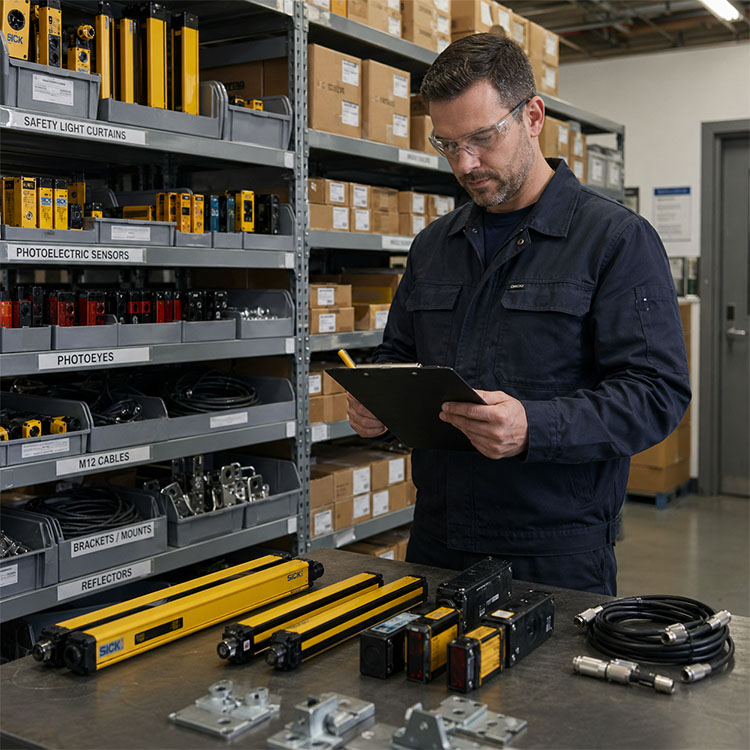
If you are specifying new equipment, start with the actual product families, not vague purchasing labels. For standard machine guarding, review the site’s safety light curtains category. For object detection, counting, positioning, and general automation, separate your stock list around photoelectric sensors instead of calling everything a “photoeye.”
Table of Contents
The Stocking Rule I Would Actually Use
Most spare parts advice is cowardly. It says “depends on your application” and then disappears.
Of course it depends. But production managers need a number before Friday.
Use this baseline:
Installed Device Type
Minimum Spare Stock
When to Increase Stock
What People Forget
Standard safety light curtain pair
1 full transmitter/receiver pair per 10 identical sets
Increase to 1 per 5 sets if the line runs 2-3 shifts or has no bypass-safe alternative
Matching receiver/transmitter series, beam spacing, range, output type
Custom or non-standard light curtain
1 complete spare per unique SKU
Stock 2 if lead time exceeds 4 weeks or dimensions are machine-specific
Mounting profile, cable exit direction, special housing length
Heavy-machine light curtain
1 complete spare per machine family
Stock 2 for hydraulic presses, press brakes, stamping, cutting, or high-vibration areas
This is not textbook purity. This is plant-floor survival.
For a small shop with 6 identical light curtains and 25 photoeyes, I would keep one complete light curtain pair, three photoeyes across the common models, several cables, reflectors, and brackets. For a larger facility with 42 safety light curtains across multiple presses and 180 photoeyes across conveyors, doors, carton handling, and packaging machines, I would build the list by SKU family: 4-5 complete light curtain sets, 18-25 photoeyes, 20+ M12 cables, and enough mounting hardware to survive a Friday-night forklift hit.
Hard truth: if your spare sensor list does not include cables and brackets, it is not a spare sensor list. It is theater.
Safety Light Curtains Are Not Just Another Sensor
A safety light curtain is a presence-sensing protective device that uses infrared beams to detect entry into a hazardous area and trigger a machine stop through a safety-rated control circuit. That means your spare inventory must respect safety function, machine stop time, resolution, detection height, and control reliability—not just voltage and cable length.
OSHA is blunt about this. In its Machine Guarding eTool for presence sensing devices, OSHA says the device must prevent or stop normal stroking when the operator’s body enters the sensing field, and that failure must stop the next stroke until corrected. That is not the same maintenance risk as a carton-counting sensor.
This is where I get opinionated: many purchasing teams are dangerous when they buy “equivalent” safety light curtains by price alone.
Can a replacement light curtain have the same 24V DC rating, NPN/PNP output, and M12 plug and still be wrong? Absolutely. If the beam spacing changes from 20mm palm protection to 40mm hand detection, if the detection range shifts from 0-3m to 5m, if the response time changes, or if the safety category/Performance Level does not match the risk assessment, the plant may have created a silent problem.
For machines with unusual geometry, blind spots, special mounting, or access on multiple sides, keep custom spares under one controlled SKU. The site’s non-standard light curtain section is the kind of category I would use when standard inventory does not fit the machine envelope.
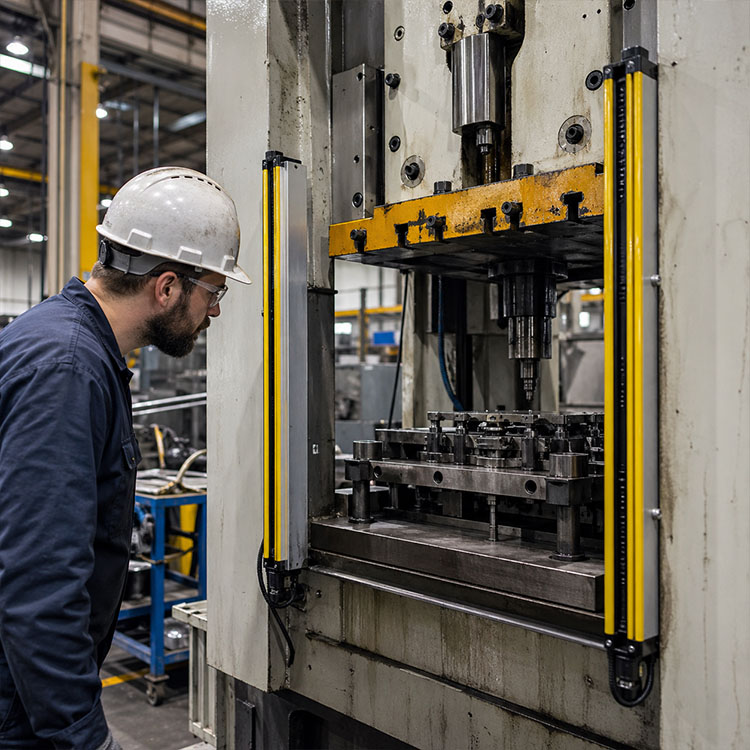
And if the machine is a hydraulic press, shear, press brake, or large forming machine, do not pretend a generic small-machine light curtain is enough. Start with heavy-machine light curtain inventory planning and work backward from the hazard.
The Real Failure Pattern: Not the Sensor, the Environment
Sensors fail. Usually, the plant helps them fail.
Dust loads the lens. Coolant attacks the cable jacket. Operators use brackets as handholds. Forklifts clip reflectors. Cleaning crews blast housings. Vibration loosens alignment. Then somebody says the sensor is “bad.”
Maybe.
But the pattern is bigger than one failed part. In wet or humid areas, spare planning should include IP-rated housings and cables. If washdown, mist, oil, powder, or outdoor exposure is involved, standard indoor light curtains age badly. For those environments, stock compatible replacements from a waterproof safety light curtain family instead of waiting until corrosion makes the decision for you.
The data backs the paranoia. The U.S. Bureau of Labor Statistics reported that private industry employers recorded 2.5 million nonfatal workplace injuries and illnesses in 2024, and the same BLS release shows 860,050 DART cases from contact incidents during 2023-2024—the bucket that includes being struck by, caught in, or compressed by equipment and objects. Read the BLS employer-reported injury release before assuming machine protection failures are rare.
Not rare enough.
A particularly ugly example appears in NIOSH FACE Report 16NY064, where a 200-ton mechanical press had light curtains, but the operator was outside the 18-inch detection perimeter when safety blocks were ejected and caused a fatal neck injury. The lesson is not “light curtains failed.” The lesson is worse: a light curtain only protects the zone it is actually designed and installed to protect.
That matters for spare stocking because a desperate replacement decision can change the protected zone.
Photoeyes Need Their Own Inventory Logic
Photoeyes are cheap until they stop a line.
A photoeye, or photoelectric sensor, detects objects using emitted light and a receiver circuit; common types include diffuse reflective, retro-reflective, through-beam, laser, fiber optic, and slot sensors. In maintenance inventory, the mistake is mixing them all under one item code, then discovering at 2 a.m. that a diffuse 8m sensor cannot replace a through-beam 40m pair on a conveyor or industrial door.
Here is how I would split them:
1. Through-Beam Photoeyes
Stock complete emitter/receiver pairs. Not one emitter. Not one receiver. A pair.
Through-beam sensors are common where longer range and stronger signal reliability matter: industrial doors, conveyors, pallet transfer, loading zones, and wide detection paths. They are usually more tolerant of dirty air than small diffuse sensors, but they depend on alignment. Keep brackets.
2. Retro-Reflective Photoeyes
Stock sensors plus reflectors. Reflectors crack, get painted over, disappear, or get replaced with the wrong size.
If your photoeye spare drawer has five sensors and zero reflectors, somebody will eventually tape something shiny to a bracket and call it “temporary.” Temporary can live for six years.
3. Diffuse Photoelectric Sensors
Stock by range and output. An 8m diffuse sensor is not the same as a short-range background suppression sensor. A red-light laser sensor used for small object detection is not the same as a general infrared sensor used for box presence.
4. Fiber Optic and Slot Sensors
Stock conservatively, but accurately. These are often used for label detection, small part detection, edge sensing, or tight spaces. The replacement must match amplifier type, fiber head, slot width, response time, and mounting geometry.
For general automation spares, photoelectric sensors should sit in a separate bin from safety light curtains. Mixing them makes maintenance look faster while making root-cause analysis worse.
A Practical Formula for Maintenance Spare Parts Inventory
Here is the formula I give maintenance teams when they need a fast, defensible answer:
I would also force one unpopular rule: no new machine gets approved unless its spare sensor list is submitted before commissioning.
That list should include beam spacing, detection height, response time, safety output type, connector, cable length, IP rating, mounting bracket, controller, relay, reflector, and replacement lead time. If engineering cannot provide that list, the project is not finished.
The Legal and Standards Angle People Avoid
Safety devices are not just purchasing items. They are part of the machine safety argument.
OSHA’s 1991 power press brake interpretation states that the safety distance for positioning light curtain devices is determined as a function of the stopping time of the slide, and it applies across types of power press brakes. That sentence should make every buyer slow down. A replacement light curtain with a different response time can affect the required safety distance.
And OSHA’s machine guarding guidance is very specific that perimeter light curtains are not point-of-operation protection when finger and hand hazards must be controlled. In plain English: a big detection field does not automatically mean safe fingers.
This is why spares should be locked to approved models. If you are using IEC 61496 Type 4 light curtains, ISO 13849-1 PL e circuits, EN ISO 13855 safety distance calculations, 20mm beam spacing for palm protection, 40mm spacing for hand detection, and dual PNP OSSD outputs, the spare must preserve that safety case.
“But the connector fits.”
Fine. So does the wrong part.
FAQs
How many spare light curtains should a factory stock?
A factory should usually stock one complete transmitter/receiver pair for every ten identical safety light curtain installations, with a minimum of one complete pair per plant and one extra pair for any high-risk, high-downtime, or long-lead-time machine cell running production every day. After that baseline, adjust by lead time, machine hazard, downtime cost, and whether the model is standard or custom.
For hydraulic presses, press brakes, stamping equipment, shears, palletizers, and guarded robot-access zones, I would move closer to one spare pair per five installed sets. For custom lengths, unusual housings, special cable exits, or discontinued models, keep one dedicated spare per unique SKU.
How many spare photoeyes should you keep in inventory?
A plant should stock photoeyes at roughly 10% of the installed base, with a minimum of two spares per sensor family, because diffuse, retro-reflective, through-beam, laser, fiber optic, and slot sensors usually cannot replace one another safely or reliably. Increase that to 15-20% in dirty, wet, high-impact, or high-cycle environments.
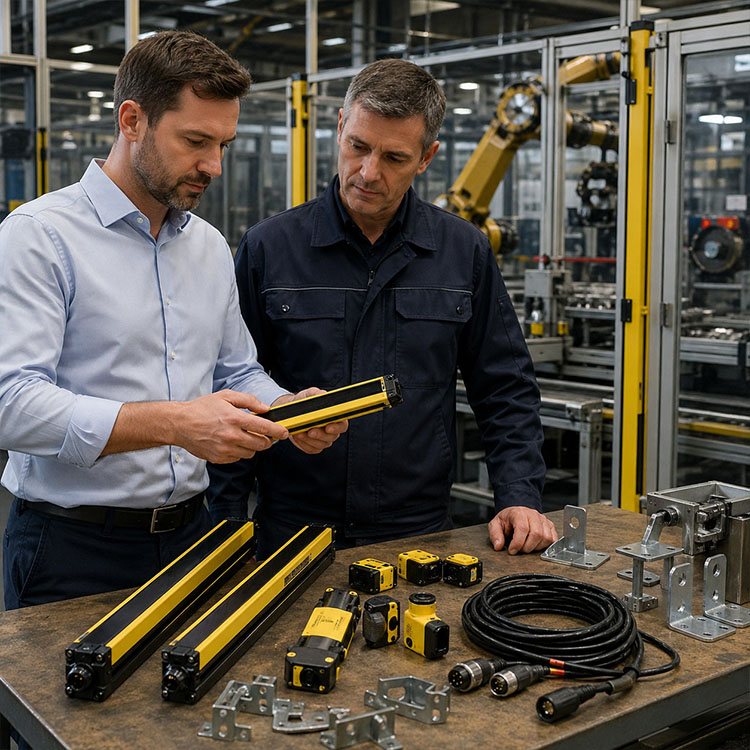
Do not forget emitters, receivers, reflectors, brackets, and M12 cables. For through-beam photo eyes, stock complete pairs. For retro-reflective sensors, stock the reflector too. For industrial door safety sensors, keep alignment brackets because those are often the first things damaged.
Should spare safety light curtains be exact replacements?
Spare safety light curtains should be exact approved replacements whenever the curtain is part of a safety-rated machine guarding function, because beam spacing, response time, detection height, range, safety outputs, and controller compatibility can affect the original risk reduction design. Equivalent parts should only be used after engineering review.
A 20mm curtain used for palm protection should not be replaced with a 40mm curtain just because the voltage and plug match. A Type 4 OSSD safety output should not be swapped casually with a non-safety photoelectric device. That is not maintenance. That is a new risk assessment.
What spare parts should be stocked besides the sensor itself?
A complete spare sensor kit should include the transmitter, receiver, sensor head, cables, connectors, brackets, reflectors, mounting hardware, protective covers, controller modules, and any safety relay or interface module required to restore the machine to its approved condition. The small hardware is often what turns a 20-minute repair into a 6-hour search.
For M12 sensor wiring, separate 4-pin and 5-pin cables, straight and right-angle connectors, shielded and unshielded cables, and common lengths such as 2m, 3m, 5m, and 10m. A spare sensor without the right cable is a paperweight.
Does stocking spare sensors replace testing and risk assessment?
Stocking spare sensors does not replace machine safety validation, lockout/tagout procedures, stop-time measurement, inspection, or risk assessment; it only reduces downtime after a known approved component fails and must be replaced with a compatible part. Safety function still depends on correct installation, alignment, wiring, testing, and documented verification.
Every replacement safety light curtain should be checked against the machine’s safety documentation. That includes stop time, safety distance, resolution, blanking or muting settings, restart behavior, and OSSD wiring. The spare gets the line running only if the safety function remains intact.
Your Next Step: Build the Spare List Before the Line Stops
Here is the move I would make this week: walk the plant, count every safety light curtain and photoeye by exact model, group them by function, then assign a spare quantity using the table above.
Do not let purchasing rename everything as “sensor.”
Create four bins: safety light curtains, photoelectric sensors, cables/connectors, and mounting hardware. Tag custom devices separately. Mark long-lead-time items. For heavy equipment, press applications, wet areas, and non-standard guarding, ask the engineering team to verify replacement compatibility before the failure happens.
If you need help matching beam spacing, protection range, output type, housing style, or custom dimensions, send the installed model list and machine photos to the Safety Curtain engineering team and build a spare parts plan before downtime writes the invoice for you.