Need the Right Safety Light Curtain for Your Machine?
Tell us your machine type and protection requirements. Our engineering team will help you select a suitable safety light curtain, sensor, or safety lidar for your project.
Get support for:
Standard and custom safety light curtain projects
OEM, integration, distribution, and factory upgrade needs
Product selection based on machine layout, sensing range, output, and environment
PLC status monitoring is not the same as safety control. It is visibility. It is diagnostics. It is a way to know whether a safety light curtain is clear, blocked, faulted, muted, reset-ready, or screaming for maintenance before the line supervisor starts blaming “sensor problems.”
That is dangerous.
It becomes dangerous when a plant quietly treats a normal PLC input, an HMI reset button, or a standard EtherNet/IP diagnostic tag as if it carries the same legal weight as a safety-rated stop circuit, a validated safety PLC function block, or a properly applied restart interlock. Why do so many factories still make that mistake?
Because uptime seduces people.
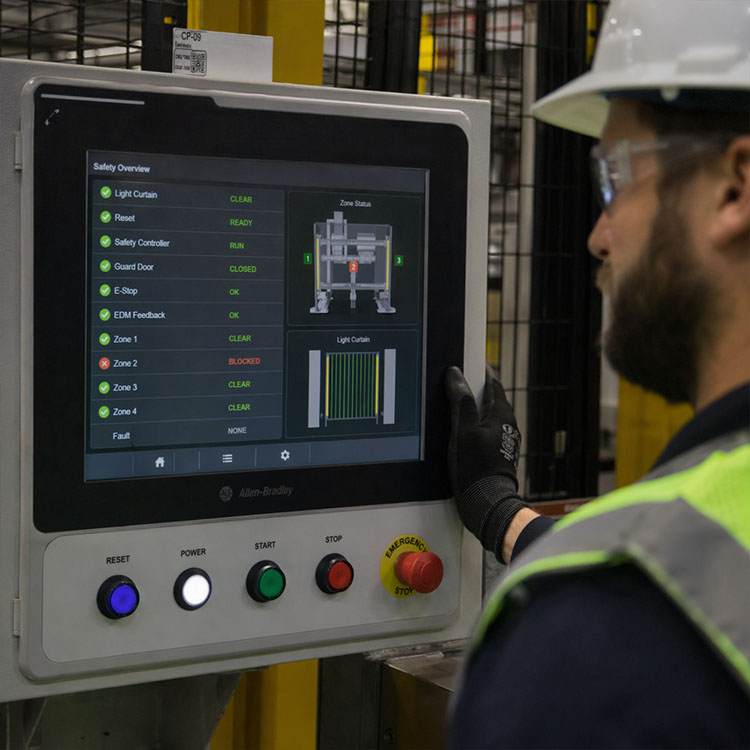
I have a hard opinion here: many “smart safety” installations are really just old safety circuits with prettier screens. The HMI looks modern. The dashboard has green icons. The maintenance team can see device status from the control room. But if the reset path, fault response, and restart logic are not built into a safety-rated architecture, the system is not smarter. It is just easier to misunderstand.
OSHA’s own presence-sensing device guidance says light curtains must stop the machine when the sensing field is interrupted, must prevent the next stroke after certain failures, and must not leave unprotected entry points around the hazard. That is the real compliance conversation, not whether the PLC can display “LC_CLEAR = 1.”
If you are choosing hardware now, start with the actual safeguarding device, not the dashboard. A safety light curtain product range gives you the physical protection layer; PLC status monitoring only reports what that layer is doing.
Table of Contents
Ethernet Reset Sounds Efficient. It Can Also Look Terrible After an Injury
Ethernet reset is one of those features that sounds harmless in a meeting. “Can we reset the safety device from the HMI?” “Can maintenance clear that light curtain fault over EtherNet/IP?” “Can the supervisor reset the safety lidar from the central panel?”
Technically, maybe.
Legally and practically, slow down.
The line I would draw is simple: Ethernet may be acceptable for diagnostics, supervised reset requests, event logging, and device configuration under controlled conditions, but it should not become a casual remote restart path for hazardous motion. Reset is not start. Reset is not permission to move. Reset is not a magic eraser for a blocked guard, a defeated interlock, or a person still standing inside a protected zone.
ODVA describes CIP Safety as a system that provides fail-safe communication between safety I/O blocks, safety light curtains, safety interlock switches, and safety controllers, with support up to SIL 3 under IEC 61508. It also explains that CIP Safety uses safety timestamps, identifiers, CRC/checksum methods, redundancy, and device-level safety identity protections rather than trusting ordinary network traffic blindly. That distinction matters. Standard Ethernet messaging and safety-rated network communication are not the same animal.
So here is the insider rule I use: if the Ethernet signal is only telling you status, it belongs in monitoring. If the Ethernet signal can clear a safety stop, enable motion, or change restart behavior, it belongs in a documented safety validation file.
And yes, that file had better survive a hostile review.
The Compliance Boundary: What PLC Monitoring Can and Cannot Do
PLC status monitoring works best when it is treated as a witness, not a judge.
A standard PLC can collect useful signals from safety devices: auxiliary outputs, OSSD state feedback, EDM status, muting indicators, bypass conditions, safety relay feedback, reset request state, fault codes, and communication health. That data is gold for downtime reduction. It helps maintenance find dirty lenses, cable faults, alignment drift, unstable reflectors, incorrect muting timing, and nuisance trips.
But it has limits.
Function
Usually Acceptable Through Standard PLC Monitoring
Requires Safety-Rated Design / Validation
Why It Matters
Display light curtain blocked/clear status
Yes
No, if read-only
Useful for diagnostics and operator guidance
Log safety device faults with timestamp
Yes
No, if read-only
Helps prove maintenance history
Show reset-ready condition on HMI
Yes
Depends on architecture
Display is not the reset function
Send remote Ethernet reset command
Risky
Often yes
Reset can affect hazardous restart behavior
Stop hazardous motion
No
Yes
Personnel protection must use safety-rated control
Monitor external device feedback / EDM
Maybe
Yes when part of safety function
Contactors can weld; feedback must be handled correctly
Modify safety zones or muting logic over network
Risky
Yes
Configuration changes affect the protective function
Restart machine after safety device clears
No
Yes
Auto-restart after access can be deadly
The better engineering move is to separate the system into two layers. The safety layer stops hazards. The monitoring layer explains what happened. When the two get blurred, investigations get ugly.
That is why models with real safety-oriented features matter. For example, a high-precision safety light curtain with EDM support is a more serious starting point than a generic photoelectric sensor wired into a normal input card. The same applies when a project needs special dimensions, dual output behavior, or PLC-facing status; a PLC-ready non-standard light curtain makes more sense than forcing a standard sensor into a strange machine frame.
Accident Files Do Not Care About Your Dashboard
Here is where the conversation gets less comfortable.
In FY 2024, OSHA listed Machine Guarding under 29 CFR 1910.212 among its top 10 most frequently cited standards. OSHA also reported 34,696 federal inspections in FY 2024 and noted that the agency and state partners cover about 130 million workers across more than 8 million worksites. In other words, enforcement is thin, but when something goes wrong, the paper trail gets very loud.
The U.S. Bureau of Labor Statistics reported 5,070 fatal work injuries in 2024, down from 5,283 in 2023, with one worker dying every 104 minutes from a work-related injury. That is not a machine-guarding-only statistic, but it is the backdrop every plant manager should remember before approving shortcuts around safety reset logic.
Look at the cases.
In September 2024, OSHA said Hailiang Copper Texas faced $253K in proposed penalties after a worker suffered a partial arm amputation while trying to clear debris near copper coil equipment. OSHA said the plant failed to install required guards or locking devices and exposed workers to hazardous contact with moving machine parts.
In December 2024, the Department of Labor said G&S Metal Products faced $182K in fines after two workers suffered amputations in separate power press incidents. One press cycled unexpectedly while being serviced; another closed without warning while scrap was being cleared. OSHA cited inadequate guarding, lockout/tagout failures, and weak machine safety training.
In April 2024, the Department of Labor said Faurecia Emissions Control Systems faced more than $300K in proposed penalties after a 26-year-old worker was fatally crushed near equipment that bends vehicle exhaust pipes. OSHA said proper machine guarding and lockout/tagout procedures could have prevented the tragedy.
No inspector is going to be impressed by a glossy HMI screen if the hazardous motion could restart from the wrong place, at the wrong time, without a verified clear view of the protected area.
Where Ethernet/IP Safety Device Monitoring Actually Helps
I am not anti-network. I am anti-fantasy.
EtherNet/IP safety device monitoring can be excellent when used for the right jobs: machine safety diagnostics, device health, zone status, fault localization, maintenance evidence, restart readiness display, and proof that a safety demand occurred at 14:03:22 instead of “sometime before lunch.”
This is where PLC status monitoring earns its keep.
A good monitoring architecture should show:
Safety device name, location, and machine zone
OSSD state or safe output state
Reset request state
Restart interlock state
EDM feedback state
Muting active, muting fault, or bypass active
Fault code and timestamp
Safety controller mode
Last safety demand
Network health, if safety-rated communication is used
Maintenance override history, if any override exists at all
But the design must make one thing painfully clear: the monitoring PLC is not allowed to silently downgrade the safety function.
If you are still selecting the protective device type, read through the safety device selection guides before wiring anything. For larger cells, conveyors, and mobile automation areas, safety lidars may be more suitable than a fixed light curtain. For metal target position feedback, a proximity sensor can support diagnostics, but it should not be mistaken for a personnel-protection device unless the full safety function is designed for that purpose.
The Reset Problem Nobody Wants to Own
Reset design exposes weak engineering fast.
If a worker opens a guard, breaks a light curtain, steps into a robot cell, or enters a press area, the machine must not restart just because the signal becomes clear again. That sounds obvious. Yet plants still create systems where clearing the beam, clicking an HMI acknowledge, or cycling a network bit creates a restart chain that nobody fully tested.
But here is the harder issue: reset location.
A reset button should usually be positioned so the operator can verify the hazard zone is clear before resetting the safety function. A remote Ethernet reset from a control room may be convenient, but can that person see behind the press? Can they see inside the fenced cell? Can they see the palletizer infeed blind spot? Can they see the maintenance technician crouched beside a jam?
If not, why are they allowed to reset it?
For compliance planning, use the machine safety standards section as a starting point, then document the actual machine risk assessment, stop time, safety distance, reset location, performance level target, validation method, and wiring design. Do not let the purchasing team reduce the project to “we need Ethernet and PLC status.”
That phrase is too small for the risk.
A Practical Architecture I Would Actually Defend
Here is the cleaner architecture I would defend in front of a safety manager, an OEM customer, or an investigator.
Safety Layer
Use safety-rated devices and logic for personnel protection. That may include Type 4 safety light curtains, safety relays, safety PLCs, dual-channel inputs, EDM, safe torque off, interlocked guards, safety mats, safety lidars, and validated safety function blocks.
Monitoring Layer
Use the standard PLC, HMI, SCADA, or MES layer for read-only visibility. Show status. Store events. Warn maintenance. Trend nuisance trips. Track reset frequency. Identify zones with repeated access. But do not let this layer become the authority for safe stop or restart.
Reset Layer
Use a reset method that matches the risk assessment. Local hardwired reset is often cleaner. Safety PLC reset may be acceptable when validated. Ethernet reset should be treated as an exception, not a default, especially where visibility of the danger zone is incomplete.
Documentation Layer
Keep the evidence. Wiring drawings. Safety function descriptions. Stop-time measurements. Safety distance calculations. SISTEMA or equivalent evaluation where applicable. Validation test records. Change logs. HMI permission rules. Password policy. Bypass authorization records.
The plant that documents this well looks professional. The plant that cannot explain who can reset what, from where, and under which conditions looks reckless.
FAQs
What is PLC status monitoring for safety devices?
PLC status monitoring is the use of controller inputs, safety tags, diagnostic bits, and HMI states to observe whether safety devices such as light curtains, interlocks, safety mats, and lidar scanners are healthy, blocked, reset-ready, faulted, muted, bypassed, or actively demanding a stop. It should improve diagnostics, not replace the safety-rated control system.
In practical terms, PLC status monitoring helps maintenance and operations understand why a machine stopped. It can reduce downtime, expose repeated nuisance trips, and support better troubleshooting. But the stop function itself must still be handled by safety-rated hardware, validated logic, and documented reset behavior.
Can Ethernet reset be compliant for safety devices?
Ethernet reset is a network-based reset command sent through an HMI, PLC, safety controller, or industrial protocol, and it can only be considered compliant when the risk assessment, safety-rated architecture, reset location, restart prevention, validation record, and applicable machine standards all support that method. It is not automatically safe because it is digital.
The biggest risk is remote reset without visibility. If the person resetting the system cannot confirm that nobody remains in the hazard zone, the design is weak. A reset should restore readiness; it should not create unexpected motion or hide an unsafe condition behind a green HMI icon.
Why is standard PLC status monitoring not enough for machine safety compliance?
Standard PLC status monitoring is not a safety function because ordinary inputs, Ethernet messages, HMI bits, and ladder tags are usually not designed, certified, or validated to provide the fault tolerance, diagnostic coverage, deterministic reaction, and restart behavior required for personnel protection. Monitoring can inform people, but it cannot be assumed to protect them.
That does not make the PLC useless. It means the PLC should sit in the correct role. Let it collect events, display device condition, and alert maintenance. Let the safety relay, safety PLC, safety controller, or validated safety network perform the protective function.
How should engineers monitor safety devices with PLC without creating compliance risk?
Safe PLC monitoring means separating safety-rated stop logic from non-safety diagnostics, then using approved auxiliary outputs, safety controller status bits, event logs, and read-only HMI indicators to report device condition without allowing ordinary Ethernet commands to defeat, reset, or restart protective functions. The boundary must be intentional, documented, and tested.
A good rule is simple: read status freely, write commands carefully. Any command that changes reset state, muting state, bypass state, zone configuration, or restart permission deserves safety review. If the function affects whether hazardous motion can occur, treat it as part of the safety system.
What should be checked before adding PLC reset safety circuit compliance logic?
PLC reset safety circuit compliance means the reset design must be reviewed against the machine risk assessment, reset location, visibility of the danger zone, manual reset requirements, restart prevention, safety-rated input structure, EDM feedback, fault handling, access control, and validation records. A reset circuit is not just a button; it is a controlled safety behavior.
Before approving it, test real failure modes. Hold the reset. Break the light curtain. Simulate a welded contactor. Drop network communication. Power-cycle the safety controller. Try to reset from the wrong screen. If the machine still behaves predictably and safely, you are closer to a defensible design.
Your Next Steps
Do not buy “Ethernet reset” as a feature until you know exactly what it resets, who can trigger it, where they stand, what they can see, and whether the safety function remains valid after the command.
For a new machine or retrofit, start by defining the hazard, safety distance, protective device type, output structure, reset method, and monitoring needs. Then match the product to the risk. If the application involves custom dimensions, PLC-facing diagnostics, EDM, dual outputs, harsh environments, or multi-sided access, send the machine layout, required protection height, resolution, sensing range, output type, voltage, cable requirement, target market, and reset expectations through the Safety Curtain quote request page.