Need the Right Safety Light Curtain for Your Machine?
Tell us your machine type and protection requirements. Our engineering team will help you select a suitable safety light curtain, sensor, or safety lidar for your project.
Get support for:
Standard and custom safety light curtain projects
OEM, integration, distribution, and factory upgrade needs
Product selection based on machine layout, sensing range, output, and environment
The Ugly Truth: Most Light Curtain Mistakes Are Math Mistakes
Safety distance kills.
That sounds dramatic, but I mean it literally: when a safety light curtain is mounted too close to the hazard, the beams can break exactly as designed, the relay can switch exactly as specified, the machine can stop exactly as expected, and the operator can still reach the pinch point before motion has died out.
So what failed?
Not the curtain. The calculation.
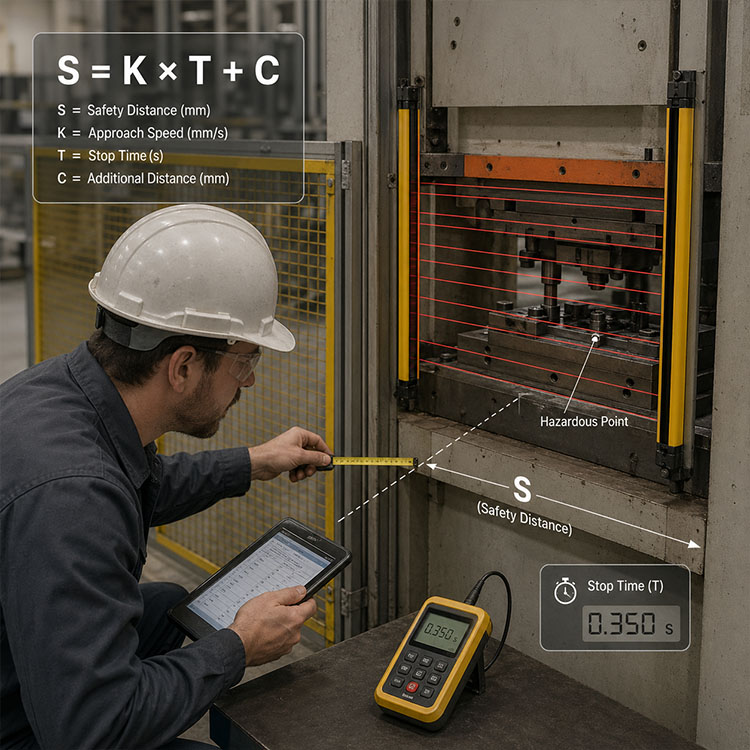
A safety light curtain safety distance is the minimum separation between the sensing field and the nearest hazardous point, based on human approach speed, machine stopping time, device response time, control-system delay, and intrusion allowance. In plain English: it is the space needed so the machine stops before a hand, arm, or body reaches danger.
That is the part too many procurement teams miss. They buy beam pitch, protective height, IP rating, and cable type. Fine. But if nobody measures stop time, nobody owns the risk.
OSHA says presence sensing devices, commonly called light curtains, must stop or prevent the normal stroke if the operator’s hands enter the sensing field, and the safety distance must be greater than the distance determined by the safety distance formula in the regulation for mechanical power presses.
Here is my hard opinion: a light curtain mounted by “where it fits nicely” is not a safety device. It is industrial decoration with wires.
If you are still selecting a device category, start with the site’s main safety light curtain product range and then work backward from the hazard, not from the cheapest model.
Table of Contents
The Formula Nobody Should Treat as a Guess
OSHA-style safety distance logic
For U.S. mechanical power press applications, OSHA gives the classic formula:
Ds = 63 inches/second × Ts
Where:
Ds = minimum safety distance in inches
63 inches/second = hand-speed constant
Ts = stopping time of the press, measured in seconds
But that simple line can mislead people. Why? Because real-world systems include more than brake time. You may also have light curtain response time, safety relay delay, PLC safety logic delay, contactor drop-out time, valve response, brake wear, and sometimes a brake monitor allowance.
The machine waits.
A modern light curtain safety distance calculation usually has to account for the whole chain from beam interruption to stopped hazardous motion, because a 20 ms sensor response means little if the clutch/brake system, hydraulic valve, or pneumatic actuator adds another 180 ms under load.
In ISO-style terms, the broad concept is often expressed as:
S = K × T + C
Where:
S = minimum safety distance
K = approach speed of the body or hand
T = total system stopping time
C = additional intrusion distance based on resolution and approach geometry
For many vertical light curtain hand-detection applications, ISO 13855 logic uses high hand-approach speeds such as 2000 mm/s in certain calculations, then adjusts based on the result, resolution, and application. For body/access protection, values and adders differ. Do not mix these casually. That is how plants end up with a curtain that detects a torso perfectly but lets fingers beat the stop.
Need a compact device for a tight retrofit? A compact safety light curtain may solve the space problem, but it does not erase the safety-distance requirement. If the stop time is long, the curtain still has to move away from the hazard.
Stop-Time Measurement: The Number Sales Sheets Cannot Give You
The most dangerous number in this whole exercise is the one nobody measures.
I have read too many accident files where managers argued about whether the operator “should have known better,” while the actual technical issue was boring and brutal: the safeguarding system did not physically prevent access before hazardous motion reached the person.
In the Donghee Alabama case, OSHA investigated complaints that light curtains and laser safety scanners were not functioning properly. The Occupational Safety and Health Review Commission decision described manufacturer-installed light curtains on helium test machines, inoperative or partially operative light curtains, and employees continuing to operate machines despite those conditions. The proposed penalties totaled $135,019, and the court rejected reliance on floor tape and behavior-based controls where physical safeguarding was needed.
Tape is not guarding.
And if you think that sounds obvious, ask why it still shows up after inspections, injuries, and production pressure. A line painted on the floor feels cheap, fast, and management-friendly. It also depends on memory, discipline, and fear. A proper safety light curtain installation should not need a perfect human to survive a bad second.
For heavier equipment, longer run-down times change everything. A hydraulic press, bending machine, palletizer, large stamping machine, or automated loading cell may need a heavy-machine light curtain with the correct protective height and range, but the calculated distance may still push the curtain farther away than the machine builder expected.
Practical calculation example
Assume a vertical safety light curtain protecting a pinch point:
Machine stopping time: 220 ms
Light curtain response time: 18 ms
Safety relay/controller response: 12 ms
Output device/contactor/valve response: 30 ms
Total response time: 280 ms, or 0.28 s
Using a simplified ISO-style hand approach calculation:
S = K × T + C
If K = 2000 mm/s, T = 0.28 s, and C = 128 mm for a 30 mm resolution example:
S = 2000 × 0.28 + 128 = 688 mm
That means the curtain should be at least 688 mm from the hazard under that simplified scenario, before you consider mounting tolerance, brake deterioration, reach-over, reach-under, pass-through, or local regulatory requirements.
Would you be comfortable installing it at 300 mm because the frame looks cleaner?
I would not.
Safety Distance Comparison Table: Fast Math for Real Machines
Use this table as an engineering sanity check, not as certification. Your final value must come from the actual machine, actual stopping-time measurement, actual safety components, and applicable standard.
Scenario
Formula Logic
Example Inputs
Result
What Usually Goes Wrong
OSHA mechanical press PSD baseline
Ds = 63 in/s × Ts
Ts = 0.42 s
26.46 in
Teams use brake time only and ignore control delays
ISO-style vertical hand detection, fine resolution
S = K × T + C
K = 2000 mm/s, T = 0.18 s, C = 0 mm
360 mm
Curtain mounted closer because “it reacts fast”
ISO-style vertical hand detection, 30 mm resolution
S = K × T + C
K = 2000 mm/s, T = 0.18 s, C = 128 mm
488 mm
Beam resolution penalty ignored
Horizontal/presence detection concept
S = 1600 × T + C
T = 0.18 s, C = 1080 mm
1368 mm
People can stand inside the protected area after reset
Reach-under risk
Access-path check, not just distance math
Bottom beam too high; open space below field
Requires redesign
Lower body, hand, or tool can pass under beams
The numbers above show why minimum safety distance light curtain work is not a one-cell spreadsheet. The formula is simple. The machine is not.
OSHA’s Table O-10 in 29 CFR 1910.217 also shows how opening size and distance from the point of operation are tied together for guarding. That matters because “reach-under gap safety light curtain” problems are often really unguarded-opening problems in disguise.
Reach-Under Gaps: The Quiet Failure Mode
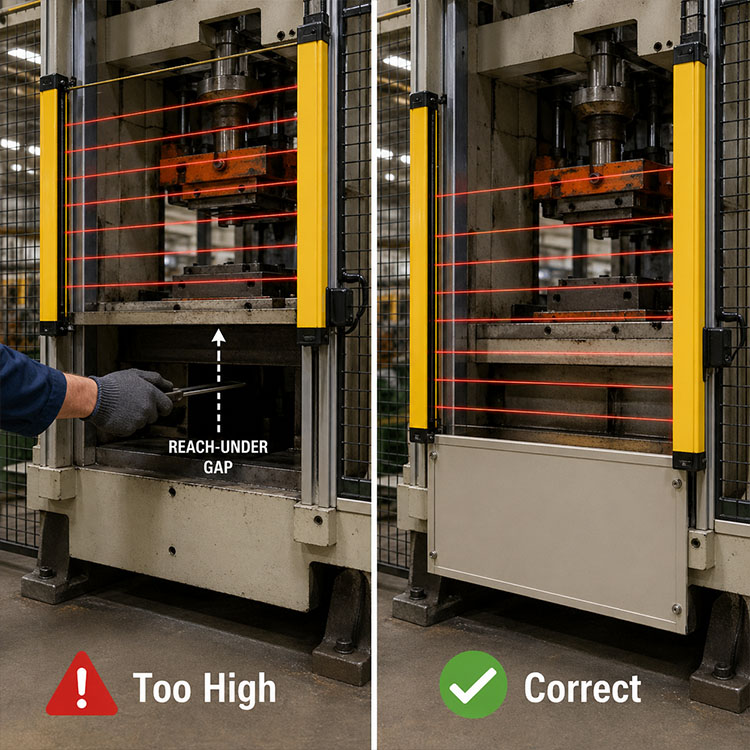
A reach-under gap is the open space below the lowest active beam or below the protective field where a hand, arm, tool, or body part can enter the hazard zone without being detected by the safety light curtain.
That sentence should make every machine builder uncomfortable.
A vertical curtain can be perfectly calculated for horizontal hand approach and still fail if the bottom beam is high enough for someone to reach underneath. A small operator does not need much room. A maintenance tech with a long tool needs even less.
So what should you check?
Measure the gap below the detection field
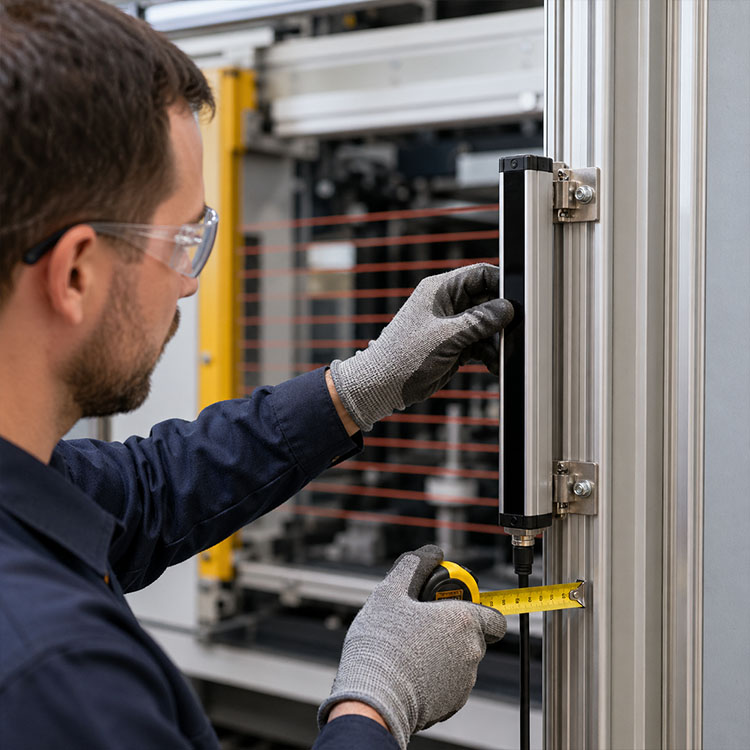
Do not measure from the housing. Measure from the actual first active beam or defined protective field. The difference matters, especially on models with dead zones, end caps, brackets, or non-detecting edges.
For compact machinery, a general use light curtain may be enough only if the mounting position prevents bypass from below, above, behind, and around the sides.
Ask whether the gap allows hand access, not just body access
This is where lazy risk assessments fail. They ask, “Can a person walk through?” Wrong question. Ask, “Can fingers, a hand, a forearm, a rod, a cleaning tool, or a part-removal hook reach the hazard without breaking a beam?”
If yes, you have a guarding problem.
Add hard guarding where light beams leave geometry gaps
Light curtains are not magic curtains. They detect what crosses their sensing field. They do not protect the side, underside, back, top, or pass-through zone unless the installation design forces all access through the field.
For complex cells with two or three access faces, a multi-sided access protection light curtain can make more sense than pretending one front-mounted curtain protects every realistic path.
Use presence detection when someone can stand inside the hazard area
If a person can pass through a vertical curtain, stand inside the machine envelope, and then have someone reset the machine from outside, your risk is not solved by the front curtain alone.
Use rear detection, horizontal light curtains, safety mats, interlocked gates, safety scanners, or safety lidar depending on the layout. For larger zones, mobile equipment paths, or irregular work areas, safety lidars may be part of the better answer.
And yes, that usually costs more. So does litigation.
The Industry Problem: Production Pressure Beats Bad Safeguarding
Here is the uncomfortable pattern. A machine runs. The curtain nuisance-trips. Maintenance gets called. Production complains. Someone raises the mute window, bypasses the scanner, tapes off a line, moves the curtain, or “temporarily” ignores the fault.
Then the temporary fix becomes the real system.
OSHA’s 2025 National Emphasis Program on amputations in manufacturing is a warning sign for anyone treating machine guarding as paperwork. OSHA selected standards including 29 CFR 1910.147, 1910.212, 1910.213, 1910.217, and 1910.219 as generally related to amputation hazards, and used 2019–2023 inspection data plus BLS amputation data to identify high-risk manufacturing codes in its Amputations in Manufacturing directive.
The injury data is not abstract either. BLS 2023 data shows machinery manufacturing with a 2.7 total recordable case rate per 100 full-time workers, while agricultural implement manufacturing was at 4.4 and farm machinery and equipment manufacturing at 5.0 in the BLS nonfatal occupational injury table. The National Safety Council reports contact-with-objects-and-equipment incidents as a major work-safety category, with 756 worker deaths in 2024 and 860,050 DART cases across 2023–2024 in its contact incidents injury data.
Those are not spreadsheet ghosts. Those are hands, arms, feet, skulls, and families.
My Field Checklist for Safety Light Curtain Installation
Step 1: Identify the actual hazard point
Name it. Do not say “machine opening.” Say “upper die closing point,” “pneumatic slide pinch point,” “robot transfer crush zone,” “index table shear point,” or “vertical lift crush area.”
Vague hazards create vague guarding.
Step 2: Measure stop time under worst credible conditions
Measure at the actual machine. Use the heaviest tooling, fastest speed, highest inertia, lowest air pressure condition if relevant, worn brake allowance if required, and real safety circuit behavior.
Step 3: Add every response delay
Include the light curtain response time, safety relay or safety PLC response, output switching time, actuator response, valve delay, brake monitor allowance, and any other interposing control element.
Step 4: Calculate minimum distance
Use the applicable standard and jurisdiction. For U.S. mechanical power presses, OSHA’s 63 in/s formula appears directly in 29 CFR 1910.217. For ISO 13855 safety distance projects, use the correct approach direction, resolution, and intrusion distance.
Step 5: Check reach-over, reach-through, reach-under, and pass-through
This is where I see the most embarrassing failures. The math says 688 mm, the curtain is installed at 700 mm, everyone celebrates, and then a technician reaches under the lower beam from a kneeling position.
Congratulations. You passed arithmetic and failed guarding.
Step 6: Validate with a test piece and a reset test
Use the manufacturer’s test rod where applicable. Confirm detection across the protective height. Confirm stop performance. Confirm no restart happens while the field is interrupted. Confirm nobody can stand behind the curtain and be trapped inside the cell during reset.
Step 7: Document the calculation
Keep the calculation record, stop-time report, wiring diagram, device model, response time, mounting distance, inspection procedure, and change-control record.
If your supplier cannot support datasheets, drawings, model selection, and engineering discussion, that is a procurement risk. The site’s contact page is the right next step when you need a model matched to protective height, resolution, sensing range, output type, voltage, mounting layout, and destination market.
FAQs
What is safety light curtain safety distance?
Safety light curtain safety distance is the minimum space between the curtain’s sensing field and the nearest hazardous point, calculated so the machine stops before a person can reach the danger zone after breaking the beam. It depends on approach speed, total stop time, device response, control delay, and intrusion allowance.
In practical terms, it is not the distance from the bracket to the frame. It is the distance from the active detection plane to the point where injury can occur. Measure the hazard. Measure the stop. Then calculate.
How do you calculate safety distance for light curtains?
You calculate safety distance for light curtains by multiplying human approach speed by total stopping time, then adding the required intrusion or penetration allowance from the applicable standard. A common ISO-style expression is S = K × T + C, while OSHA mechanical press rules use Ds = 63 in/s × Ts in specific applications.
The trap is T. It should include the full chain, not just the machine brake. Add light curtain response, safety controller response, output device delay, actuator delay, and measured machine stopping time.
What is a reach-under gap on a safety light curtain?
A reach-under gap on a safety light curtain is the unprotected opening below the lowest active beam or protective field that may allow a hand, arm, tool, or body to enter the hazard area without beam interruption. It is a geometry failure, not merely a formula failure.
Increasing the front safety distance may not fix it. You may need lower mounting, supplemental hard guarding, a second light curtain, horizontal presence detection, safety mats, or a safety scanner.
Is ISO 13855 safety distance the same as OSHA safety distance?
ISO 13855 safety distance and OSHA safety distance share the same core idea—keep people far enough away that hazardous motion stops before contact—but the formulas, variables, units, and application details differ. OSHA mechanical press rules use a 63 in/s hand-speed constant, while ISO methods vary by approach, resolution, and intrusion factor.
Do not blindly convert one into the other. Use the legal framework and standard that applies to the machine, destination market, and risk assessment.
Can I mount a light curtain closer if it has faster response time?
You can mount a light curtain closer only if the complete safety distance calculation still supports the shorter distance after including total system stopping time, device response, control delays, intrusion allowance, and bypass risks. Faster sensor response helps, but it cannot compensate for a slow brake, valve, relay, or mechanical run-down.
A 10 ms improvement in curtain response is meaningless if the machine takes 500 ms to stop under load. The slowest part of the chain usually owns the distance.
What happens if the safety light curtain is too close to the hazard?
If the safety light curtain is too close to the hazard, the machine may detect intrusion and begin stopping, but the operator’s hand or body may still reach the pinch, shear, crush, or cutting point before hazardous motion ends. The result can be an injury despite a “working” light curtain.
That is why post-installation validation matters. A green LED does not prove safe distance. A measured stop-time calculation and bypass review do.
Final Thoughts: Calculate It, Prove It, Then Mount It
Here is the line I would put on every machine guarding purchase order:
No measured stop time, no approved light curtain position.
The right safety light curtain installation starts with the hazard and ends with evidence. Measure the machine. Calculate the minimum safety distance. Check reach-under gaps. Block every bypass path. Document the result. Then choose the device, mounting style, protective height, resolution, and output architecture that actually fit the risk.
If you are designing or retrofitting a machine and need model selection support, send the machine type, hazard location, stop-time data, required protective height, resolution, sensing range, voltage, output type, mounting constraints, and target market through the Safety Curtain quote request page. Do not ask for “a light curtain.” Ask for a defensible safety solution.